
High in the Colorado Rockies, Grand County lives up to its name. Each year, from elevations of up to 14,000 feet, the snowpack from this formidable range melts to form the headwaters of the Colorado River, whose basin supplies water to more than 40 million people in a thirsty American West.
In 2020, the East Troublesome fire tore through Grand County and Rocky Mountain National Park, scorching nearly 200,000 acres of wilderness and sending sediment cascading into the rivers and reservoirs below.

“In terms of the loss and ferocity of this fire, you almost couldn’t believe what you were seeing,” says Sean Henry, environmental planning manager for Northern Water, the local public agency that manages and delivers the resource.
“We were already in extreme drought, and bark beetles had destroyed 70% of the trees in the years before.”
Without water and roots in the soil, the resulting sediment and ash slid right off the burn scar and into the water supply, causing “tremendous water quality problems.”
At the same time, Henry says that the disaster kick-started momentum to find a lasting solution. “There was a huge feeling of motivation. We knew it was time to get to work.”
Today the landscape is being restored in part through work inspired by a critical ally–the beaver.
When it comes to regulating water flow, beavers are naturals. Their once-prolific North American population created more than 300,000 square miles of wetland in the United States.
A range of groups including Grand County, Middle Park Conservation District, National Forest Foundation, Northern Water, Three Lakes Watershed Association, The River District, Trout Unlimited and the U.S. Forest Service are supporting strategies to restore the landscape.
The work includes installing natural structures called Beaver Dam Analogs, Simulated Beaver Structures and Post-Assisted Log Structures within the burn scar. The installations weave wood and soil together to mimic the ecological role of natural beaver dams by slowing down moving water and rehydrating the landscape.
Adde Sharp is a watershed program specialist for the National Forest Foundation, the nonprofit arm of the U.S. Forest Service. She says these low-tech structures act “as a speed bump to the water.”
“When you slow down the flow of water, two things happen,” Sharp says. “One, all of the sediment that the water is carrying is dropped onto the structure, slowly accreting in these deep channels. Once that happens, the water is able to access the floodplain and spread out more and more, nourishing the plant and animal communities around it.”
Paired with forest management approaches such as targeted thinning, these efforts are restoring nature’s ability to protect itself from extreme weather, all while providing clearer, sediment-free water for users downstream.
In just a few seasons of work, thousands of tons of sediment from fire runoff is already piling up against the new structures, raising the stream beds in some places by two or three feet. “It’s happening faster than we thought,” says Henry.
For Sharp, the work is proof that with a little nudge in the right direction, it’s possible to reverse course on even the most devastating natural disasters.
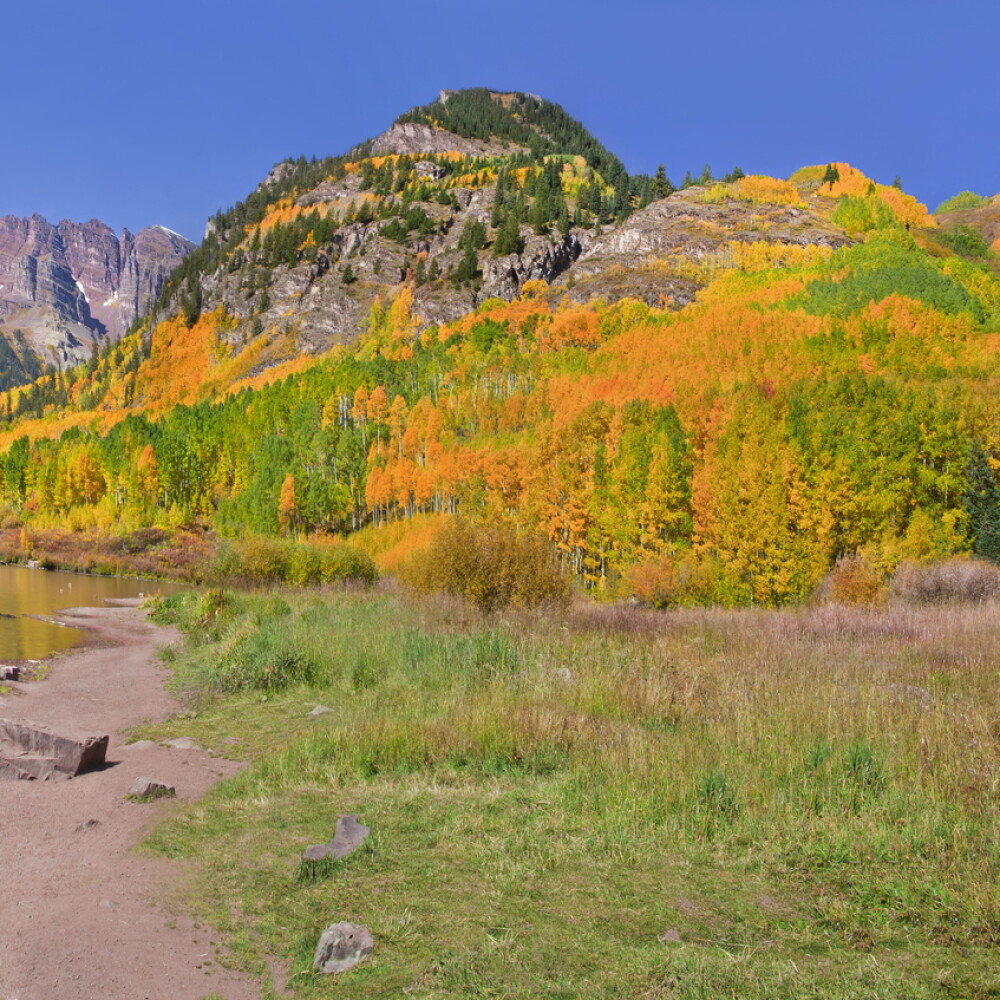
“I was driving recently, and there are already small trees coming up in the burn scar. The aspen are beginning to change color, like a little pot of gold in the black landscape.”
These same strategies are being used in nearby Kawuneeche Valley–not to recover from fire, but to protect against it. Beavers used to thrive in the Kawuneeche Valley, with scattered ponds hydrating the land.
But decades of human impacts and overgrazing by moose and elk depleted the tall willows beavers use both for food and to build their dams. As a result, crucial habitat was lost, beaver populations plummeted, and the land dried up and eroded. This left behind a vastly altered, less resilient landscape.
The Kawuneeche Valley Restoration Collaborative was formed as a partnership between Colorado State University, Grand County, National Park Service–Rocky Mountain National Park, The Nature Conservancy, Northern Water, Rocky Mountain Conservancy, the town of Grand Lake and the U.S. Forest Service. The group is working to restore the valley’s natural system to improve water quality, support wildlife and recreational opportunities, and make the area more resistant to future wildfires.
The collaborative hopes that the work will also entice more beavers to return to the valley and maintain the new structures, allowing nature to take the lead.